Fluxon Motor Fluxon Motor

7 Tips for Choosing a Reversible Gear Motor?

Time:2026-10-03 Author:Liam
0%

Choosing a Reversible Gear Motor is not simply a matter of matching voltage and speed. It is a practical decision involving torque, duty cycle, direction changes, noise, heat, and available space. A motor that performs smoothly in a showroom may struggle beside a dusty conveyor or under repeated stopping loads. That difference matters.

Austin Hughes, author of Electric Motors and Drives, offers a useful engineering principle: “The motor must be selected to suit the load, not the other way round.” This advice fits reversible applications especially well. Frequent forward and reverse operation can increase mechanical stress, gearbox backlash, and controller heating. The right choice begins with the actual machine cycle, not an attractive catalog number.

This guide presents seven practical tips for evaluating a Reversible Gear Motor. It examines rated torque, reduction ratio, braking behavior, reversing frequency, motor protection, mounting conditions, and supplier support. Pay attention to small details. A two-second reversal may seem harmless, yet repeated hundreds of times daily, it can change the motor’s service life. Check the shaft load. Measure the real starting torque. Confirm whether the gearbox tolerates abrupt direction changes.

Some choices remain imperfect. Higher torque can mean greater weight, cost, and power consumption. A compact motor may fit the frame but overheat during continuous cycling. Specifications also vary between manufacturers, so comparisons require care. When possible, test the motor under the machine’s real load, temperature, and operating rhythm. That evidence is more valuable than assumptions.
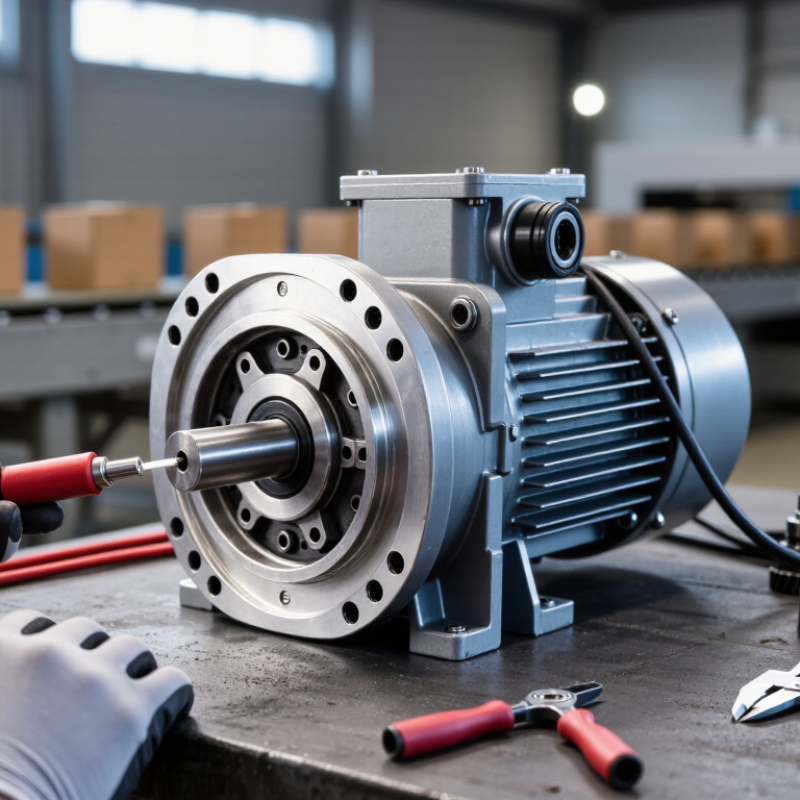
7 Tips for Choosing a Reversible Gear Motor?

Define the Application and Reversing Requirements

Choosing a reversible gear motor starts with the actual application, not the motor catalog. Define the driven load, shaft speed, operating hours, and available space. A conveyor carrying uneven boxes needs different performance from a small indexing gate. Measure the starting torque, running torque, and load inertia whenever possible. Do not guess.

Reversing requirements deserve equal attention. Record how often the motor changes direction, how quickly it must stop, and whether reversing occurs under load. A motor may tolerate occasional direction changes but overheat during rapid cycling. Check whether the control system requires a complete stop before reversing. This detail protects gears, couplings, and the output shaft. Sudden changes can create sharp torque spikes.

Backdriving is another practical concern. A suspended or inclined load may move the shaft when power is removed. Consider a holding brake or a self-locking transmission where appropriate. I once underestimated the inertia of a rotating fixture. The motor reversed correctly, but the mounting bracket shook during every changeover. That mistake showed why acceleration time matters as much as rated torque.

Review the technical datasheet for duty cycle, permissible radial load, backlash, insulation rating, and thermal limits. Confirm that the output speed remains stable in both directions. Leave a modest torque margin, but avoid excessive oversizing, which can reduce control sensitivity. During testing, monitor temperature and listen for gear noise after repeated reversals. A quiet first test is not proof of long-term reliability.

Select the Suitable Motor Type and Gear Ratio

Choosing a reversible gear motor starts with the load, not the catalog picture. The motor type determines control, noise, service life, and reversing behavior. Brushed DC motors are simple: reverse polarity, and the shaft changes direction. They suit intermittent machinery and basic controllers. Brushless DC motors run cooler and often last longer, but they need electronic commutation. That extra hardware matters. AC gear motors can work well in fixed-speed systems, although reversing usually requires suitable switching and motor protection.

Gear ratio is the quiet decision that controls usable torque and speed. A 30:1 gearbox gives more output torque than a 10:1 unit, but the shaft turns slower. Estimate the required output speed from the mechanism, not the motor label. Then check torque during starting, stopping, and jam-like resistance. Starting torque can briefly exceed running torque. Leave a practical margin, but avoid a huge safety factor without reason; it may increase size, cost, and heat. A rough calculation is better than guesswork.

For a sliding gate, measure travel speed, moving mass, friction, and duty cycle. A motor that works on a bench may overheat after repeated reversals. Check gearbox backlash when position accuracy matters. Confirm whether the rated torque applies continuously or only briefly. Also inspect the controller’s reverse delay, because instant direction changes can damage gears. I once treated nominal speed as a fixed value; real loads changed it noticeably. That assumption needed correction. Test the selected motor at low voltage first, monitor current and case temperature, and record results under realistic load. Small details reveal large mismatches.

7 Tips for Choosing a Reversible Gear Motor? - Select the Suitable Motor Type and Gear Ratio

Tip Selection Dimension Recommended Evaluation Why It Matters
1 Confirm the Required Output Torque Calculate the load torque and include acceleration, friction, incline, and starting-load requirements. Select a motor with a continuous torque rating above the calculated operating torque and a suitable peak torque capacity. Insufficient torque can cause failure to start, overheating, speed loss, or premature gear wear.
2 Choose the Appropriate Motor Type Use a brushed DC motor for simple variable-speed systems, a brushless DC motor for longer service life and frequent cycling, or an AC induction motor for robust continuous-duty applications. Verify that the motor and controller support forward and reverse operation. Motor construction affects controllability, maintenance, duty cycle, noise, efficiency, and reversing performance.
3 Select the Gear Ratio Correctly Use the basic relationship Gear Ratio = Motor Speed ÷ Required Output Speed. For example, reducing a 1,800 rpm motor to approximately 60 rpm requires a nominal ratio of about 30:1, before considering slip and load conditions. A higher reduction ratio generally increases output torque and decreases output speed, but may reduce efficiency and increase backlash.
4 Check Reversing Frequency and Direction Changes Determine how often the motor will reverse and whether direction changes occur while the shaft is moving. Use controlled deceleration or stopping before reversal when required, and confirm the controller can manage the resulting current and regenerative energy. Frequent or abrupt reversal increases mechanical shock, electrical current, gear stress, and motor temperature.
5 Evaluate Gearbox Type and Backlash Select spur or helical gearing for common compact applications, planetary gearing for high torque density, or worm gearing when a large reduction ratio is needed. Check the allowable backlash, output-shaft load, and efficiency for the application. Backlash affects positioning accuracy, while gearbox efficiency and load capacity affect heat generation and usable output torque.
6 Match the Duty Cycle and Thermal Requirements Specify operating time, rest time, starts per hour, reversing frequency, ambient temperature, and installation orientation. For continuous operation, use a motor rated for continuous duty; for intermittent operation, calculate the equivalent thermal load. A motor may handle a short peak load but overheat if the average thermal load or cycling frequency is too high.
7 Verify Electrical, Environmental, and Mechanical Compatibility Check voltage, current, controller type, braking method, shaft dimensions, mounting pattern, permissible radial and axial loads, enclosure protection, ambient temperature, and cable routing. Confirm that the output shaft and gearbox are designed for bidirectional loading. Correct compatibility improves safety, reliability, sealing performance, installation accuracy, and service life.
Practical selection formula: Output Torque ≈ Motor Torque × Gear Ratio × Gearbox Efficiency. Always verify the manufacturer’s continuous and peak ratings under the actual speed, temperature, duty cycle, and reversing conditions.

Check Torque, Speed, and Duty Cycle Specifications

7 Tips for Choosing a Reversible Gear Motor

A reversible gear motor needs enough torque to move the load in both directions. Check the required running torque and starting torque separately. Reversal can demand extra force when belts, shafts, or gears have settled. Include friction, load changes, and gearbox losses in your calculation. A practical safety margin of 20 to 30 percent is often useful. Too much margin, however, can increase cost and reduce efficiency.

Speed must match the machine’s working rhythm. Compare the motor’s output speed with the actual speed needed at the shaft. A motor that runs too fast may create vibration, noise, or harsh stopping. A slow motor may overheat while trying to maintain movement. Check whether the stated speed applies under load. No-load figures can look impressive but mislead.

Duty cycle deserves careful attention. Continuous-duty motors tolerate steady operation, while intermittent models need cooling pauses. Review operating time, rest time, reversals per hour, ambient temperature, and starting frequency. Repeated direction changes create heat inside the winding and gearbox. I once underestimated the effect of short, frequent reversals during testing. The motor moved correctly, but its housing became hotter than expected. A timed endurance test can reveal this problem before installation. Leave space around the motor for airflow, and question any datasheet that explains duty ratings vaguely.

Evaluate Power Supply, Controls, and Reversing Methods

Choosing a reversible gear motor starts at the terminals, not the catalog speed. Confirm voltage, phase, frequency, current, and startup surge under load. A 24 VDC supply may draw 10 amps briefly against a cold, stiff mechanism. Size the supply for that event, including cable voltage drop. The IEA reports that motor-driven systems consume more than 40% of global electricity. Small efficiency losses deserve attention. I have learned that nominal voltage alone is a weak selection rule.

Controls must match the motor and reversing method. For a DC motor, an H-bridge can reverse polarity electronically. For suitable AC motors, reversing contactors can swap winding connections. Use electrical and mechanical interlocks to prevent both directions closing together. Add limit switches when the gearbox drives a linear slide or rotating arm. The U.S. Department of Energy estimates motor systems use about 70% of industrial electricity. Efficient control is not merely an automation feature.

A variable-frequency drive can provide controlled acceleration, deceleration, and direction changes for compatible AC motors. However, frequent reversal can overheat windings, stress teeth, and loosen couplings. Check the manufacturer’s duty cycle, brake requirements, and permitted reversal frequency. Measure actual current with the mechanism installed. A test bench can mislead. I once trusted an unloaded current reading, and the assembled machine stalled during the first cold start. Design around measured behavior, not optimistic assumptions.

Compare Protection, Mounting, Maintenance, and Total Cost

7 Tips for Choosing a Reversible Gear Motor

Protection should match the environment, not marketing language. Check the IEC 60529 IP rating for dust and water exposure. IP65 may suit washdown areas, but chemical resistance still needs separate verification. Confirm the motor’s duty cycle, ambient temperature, and braking requirements. Reversing frequently can increase heat and wear. A higher rating is not automatically better.

Mounting errors create noise, vibration, and premature gearbox damage. Measure shaft height, flange dimensions, keyway size, and available clearance before ordering. Confirm the motor can reverse under the actual load, not only without resistance. For maintenance, inspect seals, connectors, backlash, and lubricant access. “Maintenance-free” can be misleading. In field installations, easy inspection often saves more time than sealed construction alone. Keep a spare coupling if downtime is costly.

Total cost includes electricity, labor, replacement parts, and lost production. The U.S. Department of Energy’s Motor Systems Market Assessment reports that motor-driven equipment uses about 68% of industrial electricity. Efficiency deserves serious attention. Compare rated efficiency, gearbox ratio, expected operating hours, and control losses. Request service intervals and documented test results. A lower purchase price may become expensive after one alignment failure. I would also record noise and temperature during commissioning; that simple step is easy to overlook, yet it exposes problems early. Check the warranty terms carefully, because coverage may exclude unsuitable mounting or overload conditions.

FAQS

What information should I collect before choosing a reversible gear motor?

Measure the driven load, shaft speed, operating hours, and available mounting space. Record starting torque, running torque, and load inertia. Do not guess. A conveyor carrying uneven boxes may need stronger starting performance than a small indexing gate.

How should I evaluate reversing requirements?

Record direction changes per hour, stopping time, and whether reversal happens under load. Check if the controller requires a complete stop before reversing. Rapid cycling can overheat the motor and damage gears. Sudden changes create sharp torque spikes.

How much torque margin is practical?

Calculate running and starting torque separately for both directions. Include friction, load changes, belt resistance, and gearbox losses. A 20 to 30 percent margin often provides useful protection. More is not always better. Excessive oversizing may increase cost and reduce control sensitivity.

Why can no-load speed readings be misleading?

Compare output speed under actual load conditions. No-load figures may look impressive but fail during operation. A motor running too fast can cause vibration, noise, and harsh stopping. A slow motor may overheat while maintaining movement.

How does duty cycle affect motor selection?

Review running time, rest time, ambient temperature, and starting frequency. Continuous operation needs different cooling performance from intermittent movement. Repeated reversals generate heat in the winding and gearbox. Leave clear space around the housing for airflow.

What is backdriving, and when does it matter?

Backdriving occurs when the load turns the output shaft after power removal. It matters with suspended, inclined, or rotating loads. Consider a holding brake or self-locking transmission when suitable. Test this condition carefully. Gravity is easy to underestimate.

Which technical specifications deserve close attention?

Check duty rating, permissible radial load, backlash, insulation rating, and thermal limits. Confirm stable output speed in both directions. Verify that the shaft and mounting structure handle reversal forces. A quiet first test proves very little.

How should I test a reversible gear motor before installation?

Run repeated reversals under a realistic load. Measure housing temperature during short and long cycles. Listen for gear noise, vibration, and mounting movement. A rotating fixture once seemed acceptable but shook during every changeover. Acceleration time mattered more than expected.

Conclusion

Choosing the right Reversible Gear Motor begins with a clear understanding of the application. Define the load, movement direction, operating environment, reversing frequency, and required positioning accuracy before comparing options. Then select a suitable motor type and gear ratio based on the balance between torque, speed, efficiency, and available space. Carefully review the motor’s rated torque, starting torque, output speed, duty cycle, and thermal limits to ensure reliable performance during repeated forward and reverse operation.

It is also important to evaluate the power supply, control system, and preferred reversing method, such as switches, relays, or electronic controllers. Check protection ratings, mounting requirements, noise levels, maintenance needs, and ease of installation. Finally, compare the total cost rather than focusing only on the purchase price. A dependable Reversible Gear Motor should provide the required performance, durability, control flexibility, and long-term value for the specific application.

Liam

Liam

Liam is a dedicated marketing professional with a profound expertise in the industry, where he excels at highlighting the unique advantages of our core products. With a keen understanding of market trends and consumer needs, Liam frequently updates our company’s professional blog, providing......